Fill in your details and our team will get back to you shortly.
Starting a business can be exciting, but knowing where to begin can feel overwhelming. You may have a business idea, a skill you want to turn into income, or a plan to build your own company, but the next steps are not always clear.
The good news is that you do not need to have everything figured out on day one.
Whether you want to start a small business, build an online business, turn your skill into a service, or develop a larger company, the process starts with understanding the problem you want to solve, your target customers, your budget and the right way to launch.
This guide explains how to start a business from idea validation to your first customers, including practical steps for starting a business in India.
The first step is not registering a company or creating a logo.
The first step is understanding what you want to offer and who you want to serve.
A simple business journey looks like this:
Idea → Research → Validation → Business Plan → Budget → Setup → Marketing → First Customers → Growth
Starting with this sequence can help you avoid spending too much money before you know whether there is genuine demand for your product or service.
Current entrepreneurship guides also recommend validating the problem and speaking to potential customers before making major investments.
If you want to start your own business, begin with a problem rather than only thinking about the product. Ask what problem you are solving, who experiences it, how people solve it today, what you can offer differently, and whether someone would pay for your solution.
Do not spend heavily before testing demand. Talk to potential customers, understand their problems and test your offer through a simple landing page, Instagram page, WhatsApp enquiries, pre-orders, trial service, sample product, small pilot or Google Form. The goal is to get evidence before making a large investment.
Define your target customer by location, profession, needs, buying behaviour and preferred platforms. Study competitors’ pricing, products or services, websites, social media, reviews, customer complaints, offers and marketing strategy.
You do not always need a completely unique idea. You need a clear reason for customers to choose you. Your difference could be better service, faster delivery, local expertise, convenience, quality, personalised service, affordable pricing or specialised expertise.
A practical business plan should answer: What are you selling? Who are you selling to? What problem are you solving? Who are your competitors? What will you charge? How will customers find you? What will it cost? What is your first-year goal? Keep the plan useful and actionable.
Separate one-time costs such as equipment, website setup, branding and initial inventory from monthly costs such as rent, salaries, software, advertising and accounting. A service business may start with fewer physical resources than an inventory-heavy business.
If digital marketing training is part of your plan, you can review digital marketing course fees in Solapur when planning that investment.
Common models include service businesses, product businesses, subscriptions and hybrid businesses. Choose a model that matches your skills, resources and target market.
You do not necessarily need a large office, large team or expensive setup to start a small business. A lean approach is: Start small → Test demand → Get customers → Improve → Reinvest → Expand.
If you are planning to start a business in India, legal and tax requirements depend on your business type, structure, location and activities. Possible structures include sole proprietorship, partnership, LLP, One Person Company and Private Limited Company. Relevant registrations or licences may also apply. Verify current requirements through official government portals or a qualified professional before registering.
Keep personal and business finances organised. Track revenue, expenses, profit, taxes, outstanding payments, supplier payments, marketing costs and cash flow. Always know how much money came in, how much went out, and what remains available for the next month.
Customers often research businesses online before contacting them. Consider a website, Google Business Profile if you operate locally, and social media platforms where your customers actually spend time. Your website should clearly explain what you offer, who you help, why customers should choose you and how to contact you.
A good product can still struggle if potential customers cannot find it. Digital marketing can build visibility through SEO, social media marketing, Google Ads, content marketing, email, WhatsApp and video marketing. If you want to build these skills, explore the Digital Marketing Course in Solapur. You can also find answers to common course questions in the digital marketing course FAQs.
Choose two or three channels that match your audience instead of trying everything at once. For a local business consider Google Business Profile, Local SEO, Instagram, WhatsApp and partnerships. For an online business consider SEO, Instagram, YouTube, content marketing, email and paid advertising.
If Instagram is part of your customer acquisition plan, use a structured Instagram marketing approach rather than posting randomly.
Use your existing network, ask for referrals, share useful social media content, conduct targeted outreach, offer a suitable starter package, and collect genuine customer feedback. Your first customers can teach you about pricing, delivery and customer expectations.
Do not wait for a perfect logo, website, office or social media feed before trying to sell. Build enough credibility and functionality to serve customers properly, then use feedback to improve. Build → Launch → Learn → Improve.
If you are starting with only an idea, follow this roadmap:
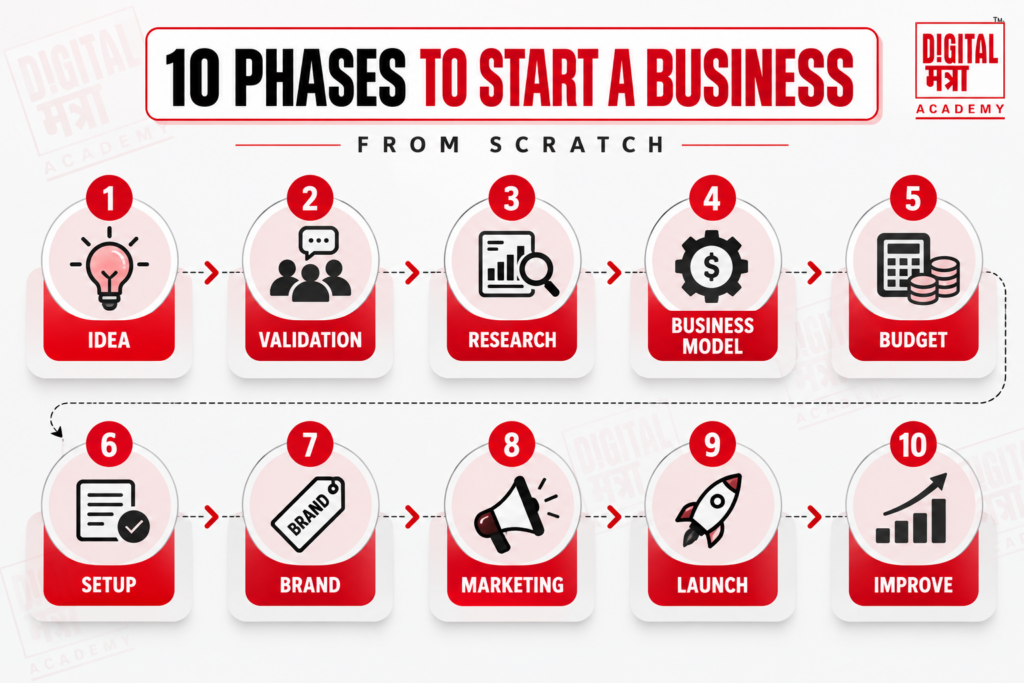
This how to start a business from scratch approach keeps the process manageable instead of trying to build everything at once.
You do not need to know everything before starting, but you do need to be willing to learn. Build knowledge in customer research, pricing, sales, marketing, financial management and basic legal requirements. For specialist accounting, tax or legal matters, work with qualified professionals. If you are exploring your skills and career direction, our career guidance resources can also help.
1. Starting without understanding the customer.
2. Spending too much before validation.
3. Copying competitors completely.
4. Setting prices without understanding costs.
5. Ignoring marketing.
6. Mixing personal and business money.
7. Trying every marketing channel.
8. Waiting for everything to be perfect.
9. Ignoring customer feedback.
10. Growing too quickly.
If you want to move from idea to action, use this simple plan.
Days 1–5: Define your idea, customer, offer and competitors.
Days 6–10: Validate demand and collect feedback.
Days 11–15: Finalise pricing, costs, business model and plan.
Days 16–20: Set up applicable requirements, payments, website and social profiles.
Days 21–25: Prepare content, Google Business Profile if relevant, customer communication and outreach.
Days 26–30: Launch, collect enquiries, get first customers and improve from feedback.
The goal of the first 30 days is not to create a huge company.
It is to move from idea → evidence → first customers.
Do not focus only on revenue.
Look at:
If customers are buying, returning and referring others, you can start thinking about scaling.
Growth could mean:
■ Clearly defined business idea
■ Specific target customer
■ Validated problem
■ Competitor research
■ Clear product or service
■ Pricing
■ Startup budget
■ Business plan
■ Appropriate business structure
■ Required registrations/licences checked
■ Payment/accounting setup
■ Website or online presence
■ Marketing plan
■ Customer acquisition strategy
■ First-customer plan
Learning how to start a business is not about finding one perfect formula. Start with a real problem, understand your customer, validate your idea, research competitors, create a simple business model and budget, complete applicable setup requirements, build your online presence and start finding customers.
Start small. Test your idea. Learn from customers. Improve your offer. Then grow.
If you want to build the digital skills needed to promote a new business through SEO, social media, Google Ads and other channels, explore the Digital Marketing Course in Solapur.
Join Solapur's most trusted institute. Free demo class available. Limited seats per batch.
📞 Call Now: +91 9595613531